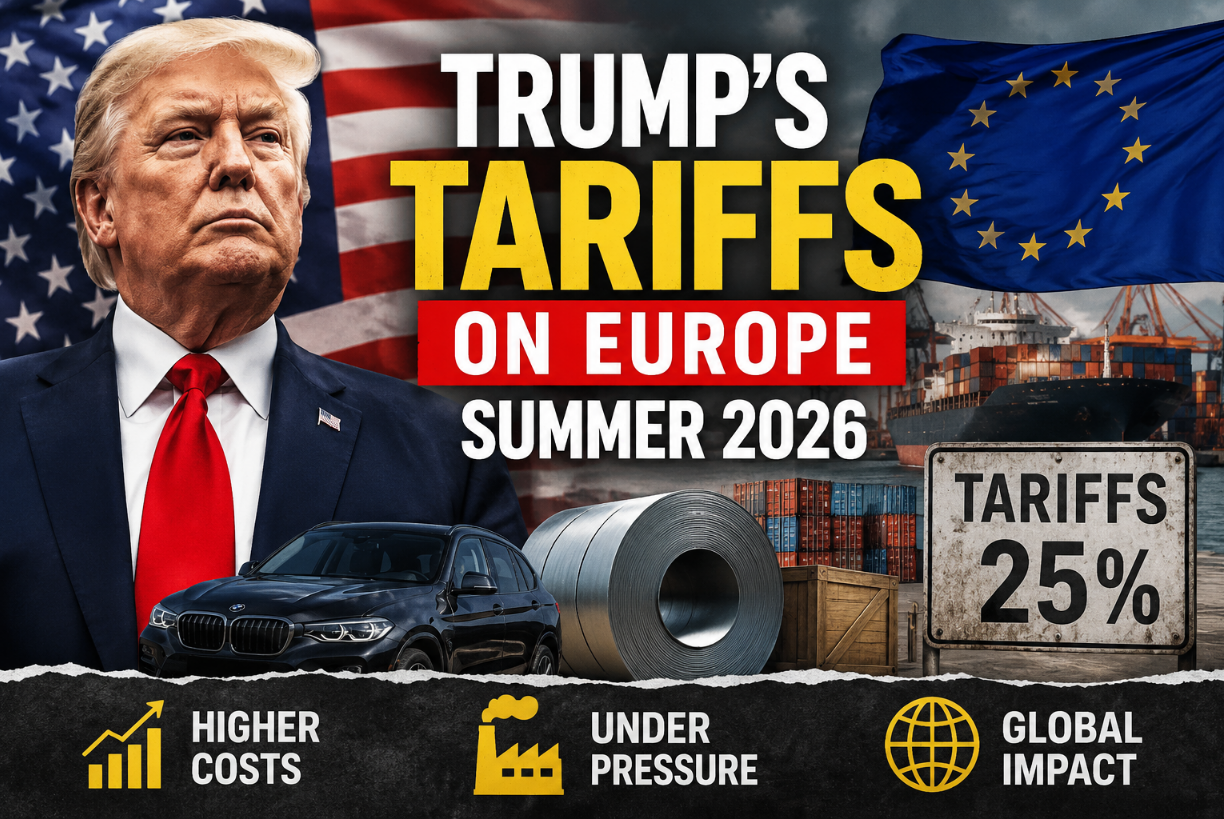
Summer 2026 Could Become a Turning Point for US-European Economic Relations
Trade tensions between the United States and Europe are escalating once again.
After months of political pressure and growing economic disagreements, former US President Donald Trump announced a new wave of tariffs targeting European imports, triggering concern among governments, businesses, and financial markets across both sides of the Atlantic.
Many analysts now fear that summer 2026 could become the beginning of a much broader economic confrontation between two of the world’s largest trading blocs.
What the New Tariffs Target
The latest tariff measures are expected to affect multiple European industries, including:
- Automotive manufacturing
- Industrial machinery
- Luxury goods
- Steel and aluminum
- Green technology products
- Agricultural exports
Trump argued that the tariffs are necessary to protect American industries and reduce what he describes as unfair trade imbalances between the United States and the European Union.
However, European officials strongly criticized the move, warning that new trade barriers could damage economic growth at a time when both economies are already facing inflation pressure and slower industrial activity.
Europe Responds With Concern
Across Europe, political leaders reacted quickly.
Officials in Germany, France, and other EU member states warned that escalating trade tensions could hurt manufacturing, exports, and employment throughout the region.
Germany appears especially vulnerable due to its export-driven economy and heavy dependence on international industrial trade.
Several economists warned that new tariffs may increase pressure on European industries already struggling with:
- High energy costs
- Slower industrial production
- Weak economic growth
- Supply chain disruptions
- Competition from Asia and the US
The timing of the tariffs has added to broader anxiety surrounding Europe’s economic outlook.
Financial Markets Are Watching Closely
Investors reacted cautiously as news of the tariffs spread through global markets.
Many analysts fear that a larger trade conflict between Washington and Brussels could:
- Slow global economic growth
- Increase manufacturing costs
- Reduce international investment
- Disrupt supply chains
- Increase inflation pressure
Some European business leaders are also worried that prolonged trade tensions may weaken confidence in already fragile industries.
Several multinational companies are now reportedly reviewing supply chains and export strategies in response to growing uncertainty.
Trump’s Economic Strategy
Trump has consistently defended aggressive tariff policies as part of his broader “America First” economic strategy.
He argues that tariffs help protect domestic manufacturing, reduce trade deficits, and encourage companies to invest more heavily inside the United States.
Supporters believe stronger trade barriers can help revive American industry and reduce dependence on foreign imports.
Critics, however, warn that tariff wars often create higher costs for businesses and consumers while increasing geopolitical tension between allies.
Europe Faces a Difficult Economic Moment
The tariff dispute comes at a particularly sensitive time for Europe.
Several EU economies are already dealing with:
- Weak industrial growth
- Rising public debt
- Energy market instability
- Slowing consumer demand
- Political uncertainty
Some analysts fear that additional trade pressure from Washington could deepen recession risks in parts of Europe, particularly in export-oriented economies.
For ordinary Europeans, concerns about rising prices, economic uncertainty, and job security are becoming increasingly personal.
A Larger Global Shift Is Happening
The growing tension between the United States and Europe reflects a broader transformation taking place in the global economy.
Governments around the world are increasingly prioritizing:
- Domestic manufacturing
- Economic security
- Strategic industries
- Supply chain independence
- Technological sovereignty
As globalization slows and geopolitical competition intensifies, trade relationships that once seemed stable are becoming more unpredictable.
This shift is affecting everything from semiconductors and AI to energy policy and industrial production.
What Happens Next?
European officials are expected to continue negotiations with Washington while also preparing possible countermeasures if the tariffs remain in place.
Some experts still hope both sides will eventually reach compromises to avoid a full-scale trade war between the United States and the European Union.
Others believe the conflict may continue escalating as economic nationalism becomes a larger political force globally.
What is already clear is that the relationship between America and Europe is entering a more uncertain period.
And for businesses, investors, and ordinary citizens alike, the consequences of that shift may soon become impossible to ignore.